
Finding work
Facebook Groups for Contractors: Which Kinds Actually Bring Jobs
The short answer
Neighborhood and town groups bring the most contractor jobs, most often, because the person posting is the homeowner. Networking groups bring fewer posts, and some of those jobs are bigger. County groups are the same kind of ask across a wider map. Parent groups are worth joining and not worth checking twice a day. Buy-sell-trade groups are for objects, not services. You still lose the work if you see the post two days late, or if the group's settings hold your reply for approval.
Key takeaways
- If you only watch one tier, watch neighborhood and town groups. The poster is the buyer.
- Networking groups are mostly contractors selling to each other. A homeowner or a property manager still shows up, and that job can be a building instead of a faucet.
- Join and get approved before you need the group. A reply stuck in an approval queue until after lunch is a reply that lost.
- Reply as yourself. Keep the business Page for proof after they click your name.
- Four to six groups and about twenty minutes a day beats joining fifteen and scrolling all evening.
Why do contractors miss the job?
Somebody in your town posts at 7:40 on a Tuesday. "Water heater is leaking - need someone today, who do you use?" By 7:52, three guys have answered. One already gave a price range and said he could be there by nine.
You see the post Thursday night, between a lawn mower ad and a lost cat.
That's the real problem with Facebook groups for contractors. The work was there. You were under a sink. Timing beat you, not competition.
And the place isn't small. Almost 1.8 billion people use Facebook Groups every month, and there are 25 million monthly active public groups, per Meta's October 2024 announcement. Your service area has a dozen of them, each with its own personality and its own rule about advertising.
Here's the honest map.
What are the five types of Facebook groups you'll run into?
You'll run into five kinds of groups. They are not equal. Town groups are where homeowners ask for a name. The other four are a mix of useful, occasional, and noise.
| Group type | Who's in it | What it's good for | What it costs you |
|---|---|---|---|
| Neighborhood and town groups | Homeowners, renters, parents, a few realtors | Job posts, "anyone know a plumber" asks | Time, and post approval queues |
| Contractor and trade networking groups | Subs, suppliers, salespeople, property and real-estate managers | Occasional homeowner asks, building-sized work, finding a sub | Fewer relevant posts, constant pitching |
| Regional and county groups | A whole county, mixed towns | Wider reach, storm and emergency work | Noise, and jobs an hour away |
| Mom and parent groups | Parents in your town | An occasional "who do you use" thread | Mostly off-topic, low signal |
| Buy-sell-trade groups | People buying and selling stuff | Almost nothing job-related | Your name, if you spam it |
Neighborhood and town groups
These are the local Facebook groups that matter. Your town has a handful of them. The next town over has more. Questions get posted in plain homeowner language - "does anyone know a good plumber," not "seeking licensed plumbing contractor" - and the person asking is holding a wallet. If a trade page helps you think about the work, plumbing jobs from neighborhood groups covers the plumbing version of this.
Contractor and trade networking groups
Most of these double as Facebook groups for small business owners, and most of the traffic is what you'd expect: subs looking for work, suppliers pushing material, hiring posts, and somebody selling a CRM, a lead pack, or shirts. That's the bulk of it.
It isn't all of it. Homeowners turn up in these groups asking for a trade. Sometimes they got burned somewhere else. Sometimes the networking group is simply the biggest local group they could find, so that's where they ask. The bigger accounts show up too - property managers, real-estate managers, people holding a portfolio of buildings who need a plumber for a twelve-unit building instead of a house.
Fewer homeowner posts than a town group gets. But the ones that land can be bigger. One networking group we monitor is our single biggest source of leads by volume - not because it's busier, but because what comes out of it runs larger than a dripping faucet.
Regional and county groups
County groups pull from forty towns at once. That's an advantage during storm season - a roofing call after a wind event travels fast, and roofing jobs after a storm is the trade where that shows up hardest. The cost is distance and noise. Depending on your service area, half the posts are outside your radius.
Mom and parent groups
Parents asking parents. Most of it is school closures, pediatrician recommendations, and somebody's lost dog. Every so often a parent posts "anyone know a reliable plumber, our kitchen is a disaster" and gets twelve replies in an hour. Worth joining. Not worth checking twice a day. Watch it, don't live in it.
Buy-sell-trade groups
Buy sell trade Facebook groups exist for stuff. Couches. Snowblowers. Someone selling a used water heater is not your customer. Every so often a garage cleanout turns into a dumpster run, and junk removal jobs is where that turns into money. Otherwise you're reading classifieds.
Which type actually gets you jobs?
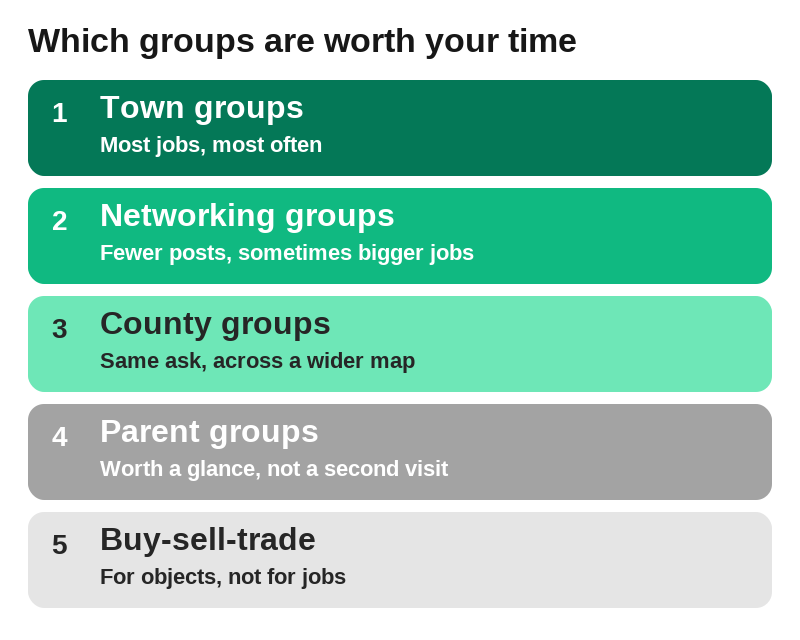
There's no single best type. Anyone handing you a ranked list of "best Facebook groups for contractors" hasn't tried to book work out of one in February. Ranked by what each one is actually good for:
- Neighborhood and town groups. Most jobs, most often. The poster is the buyer. That's the whole reason. If you only watch one tier, watch this one.
- Contractor and trade networking groups. Fewer posts, sometimes bigger jobs. Mostly subs, suppliers, and salespeople. Then a homeowner asks, or a property manager posts a building, and one reply beats a week of faucet answers.
- Regional and county groups. Same intent, wider map. Worth it if you cover the ground.
- Mom and parent groups. Watch-only. An occasional recommendation thread, buried under school news.
- Buy-sell-trade. Last. It's a classifieds board with a comment section.
The logic on town groups is simple. Neighborhood Facebook groups are where homeowners ask other homeowners who to call. Meta has described that same behavior. In 2021 it said you could use the Recommendations feature in Neighborhoods to get a local suggestion, including a locksmith, per Meta's May 2021 announcement. That's the lane with the most traffic.
Traffic isn't the same as value, though. Town groups hand you more jobs, more often. Networking groups hand you fewer, but some of those are a commercial building instead of a house. Neither is the wrong room. They're different rooms. Mom groups you glance into. Buy-sell-trade is for objects.
Which privacy settings decide whether you get seen?
Facebook documents this in its Help Center on group privacy settings, and it matters more than most contractors realize.
- Public groups can be seen by anyone on or off Facebook. Non-members can even post.
- Private groups only show posts to current members. If the group is visible, anyone on Facebook can find it and ask to join.
- Hidden private groups are findable only by members and invited people. You can't search your way in.
- Public groups with 10,000+ members created 30+ days ago can't switch to private. The big ones stay open.
- Admins can require post approval and participant approval. Two separate controls, per the Help Center page on public group posting.
That last one is the one people get wrong. Post approval sounds like a wall. Usually it's a door with a latch. Post approval means your reply sits in a queue until an admin clicks. Participant approval means you have to be approved as a participant before you can comment at all. You find the post at 8:02, reply at 8:03, and it goes live at 1:15 - after the other guy already booked the work.
The fix is boring and it works: join before you need it. In most groups, public ones included, joining and getting approved once clears you, and after that you comment in the thread like anybody else. It's a one-time setup step, not a permanent handicap. Join your four to six groups, request approval, get it done on a Sunday night. Then a Tuesday leak is just a Tuesday leak.
Know the setting before you count on the group. A big public group you can read but haven't finished joining is a viewing gallery, not a lead source.
Should you post as your Page or as yourself?
Where a group allows it, a Page with Facebook access can post, comment, and react as the Page, and those actions show as coming from the Page (Help Center on posting as a Page). Useful for brand consistency. Terrible for a "need a plumber today" thread.
Most neighborhood groups are built for people. A Page comment on a homeowner's urgent question reads like an ad, and every admin has seen a thousand of them. So the rule:
What gets contractors removed from a group?
Nobody gets banned for one honest reply. They get banned for these:
- Posting "we do that, call us" in a group with a no-advertising rule. Read the pinned rules. Ten seconds.
- Dropping the same reply in ten groups. That's the pattern admins recognize as spam, even when each individual comment is fine.
- Posting a truck photo with your phone number as your own post. Unless the group has a promo day, that's an ad.
- Arguing with an admin in the comments. If a post gets pulled, read the rule that explains it and move on. Public fights get you removed and remembered.
There's a difference between being helpful in public and advertising in public. One gets you kept. The other gets you removed, and in small towns the admins talk to each other.
What does a 20-minute-a-day routine look like?
No funnel. No content calendar. This is the whole of how to use Facebook groups for business when you're the one holding the pipe wrench - and how to get leads from Facebook groups without giving up your evenings.
- Join four to six groups. Not fifteen. At least two should be town-level where you actually work - the town you live in plus the two or three you want steady work in.
- Read the rules once and write them down. One line each: does this group allow business replies, and do posts need approval? Request participant approval while you're there.
- Morning pass, eight minutes. Open each group, sort by recent, scan for the words you actually sell: leak, no heat, roof, tree down, cleanout, estimate.
- When a job posts, reply on the original thread in minutes. Line one: availability. Line two: a price range, not a number you'll regret. Line three: one line of proof or a photo. No essay.
- Skip the second pass in the afternoon. Two visits a day is plenty. Fifteen is a whole unpaid job.
That's about twenty minutes if nothing good lands, five if it does.
Where does this break down?
Now the honest part. You can't watch fifteen groups across your whole service area while you're on a ladder. You will miss posts. Facebook's feed buries them under a bakery photo and a political argument, and the first reply usually wins - not the best one.
Most social media marketing for contractors advice assumes somebody on your payroll has time to scroll. You don't have that person. Facebook group marketing gets sold as a funnel. It's really a race, and the race happens at 7:40 in the morning.
That's the gap SpotTheJob fills. It watches the neighborhood groups in the towns you work, filters the posts down to your trade and your service area, and sends the match by email or text, typically within 5 minutes of them posting. You get the post, not a mystery feed. You reply on the original thread, same as you always would. No marketplace, no shared lead, no five guys paying for the same homeowner.
See how the alerts work and the trades we cover. If you're in plumbing, HVAC, roofing, landscaping, junk removal, or general contracting work, you're in scope.
What should you do next?
Connecticut is small enough that your reputation travels faster than any ad. Reply fast, quote honestly, show up when you said you would, and the groups will do the marketing for you.
If you're already doing that and still losing work to whoever saw the post first, that's a watching problem, not a skill problem. Start with who is behind SpotTheJob if you want to know who's running this. And if a filter is wrong, tell Will. He fixes it.
Frequently asked questions
Are there Facebook groups just for contractors?
Yes, plenty, and most of the traffic is contractor-to-contractor: subs, suppliers, hiring posts, people selling marketing services. Don't write them off. Homeowners do ask for a trade in there, and property managers post bigger work. Town groups produce more often. Networking groups produce less often but sometimes bigger.
Can I post my business in a neighborhood group?
Sometimes. It depends entirely on that group's rules and whether they run promo days. Read the pinned post first. Replying helpfully to a homeowner's question is almost always fine. A standalone ad usually isn't.
Do buy-sell-trade groups work for contractors?
Rarely. They're built for goods, not services. The exception is work that's basically hauling - cleanouts, removals, debris. Everything else is wasted attention.
How many local groups should I join?
At least four to six, weighted toward the towns where you want work. More groups means more noise and more missed posts, not more jobs. Depth beats coverage.
Is Facebook marketing worth it for a small contractor?
For reputation and word of mouth, yes. For finding homeowners at the exact moment they need you, only if you're fast, which is why the timing problem matters more than the posting problem. On the numbers: nobody has reliable data on average group size, group-versus-Page engagement, or what share of homeowners use Facebook rather than Google to find a trade. If someone quotes you a figure, ask where it came from.
See the post while the thread is still new
Tell us your trade and the towns you work. We watch the neighborhood groups and send the match by email or text, typically within 5 minutes of a homeowner posting.
14-day free trial. No credit card. You'll receive job alerts within the first day.
Start free trialKeep reading
Finding work
How to Find Contractor Work in Connecticut, Town by Town
Milford, Shelton, Watertown, East Lyme, and Winchester posted the most homeowner job requests in the 30 days to November 27, 2026. The work is in town Facebook groups, and the first reply usually wins it.
· 8 min read
References
- Introducing New Facebook Local Tab, Messenger Communities, AI Integrations and More. Meta, October 2024.
- Reid Patton. Connecting Local Communities on Facebook. Meta, May 5, 2021.
- What are the privacy settings for Facebook groups?. Meta.
- Difference between a member, participant and visitor in a public Facebook group. Meta.
- How do I post, comment, or react as my Page in a Facebook group?. Meta.